
Temporarily
On time, the architectures we only understand too late, and the temporarily occupied territories hub we have launched at KCL.

In 2017 I held a research fellowship at Voronezh State University. Having just finished two years of work on how Russia used memory to frame and sell its 2014 aggression against Ukraine, I was trying to broaden my focus. I had a clean new project on how local Russian media framed Europe (for what it is worth they framed it rather warmly) but I kept being distracted by the Surzhyk I heard in the villages, or people speaking Ukrainian words without knowing they were Ukrainian; by erudite and generous professors who could declaim for hours on the Banderisation of a neighbouring country they had never visited and knew almost nothing about; and above all by a chance meeting with displaced people from the so-called Donetsk People’s Republic.
I already knew many people from Donetsk, and my new acquaintances were similar in not fitting any of the Russian propaganda written about them. They liked Voronezh and its Soviet solidity but they also felt unwelcome and out of place. They blamed Moscow and Kyiv and ‘local oddballs’ for the violence and for the promises, from every direction, that had never materialised. In their view, they had been offered grand visions by people who then proceeded to destroy their homes and get annoyed when they turned up homeless in their neighbourhood.
At the time I thought these conversations exculpatory to the Russians (perhaps understandable in the context of a conversation with a foreigner in Voronezh) but I also felt they were more real, more honest than much of the analysis I had been doing. I now wonder whether it felt more meaningful because it was more immediate. What I was actually listening to was people’s impressions of several realities being abruptly replaced, when everyone who might have helped had instead described their suffering back to them, and when the daily work of surviving leaves no room to notice the systems being assembled around them, or to ask what those systems are for. In 2017, nobody paid much attention to the occupied territories or Russia’s war on Ukraine. In 2026, that is no longer the case for the war but there is still too little attention paid to the occupied territories.
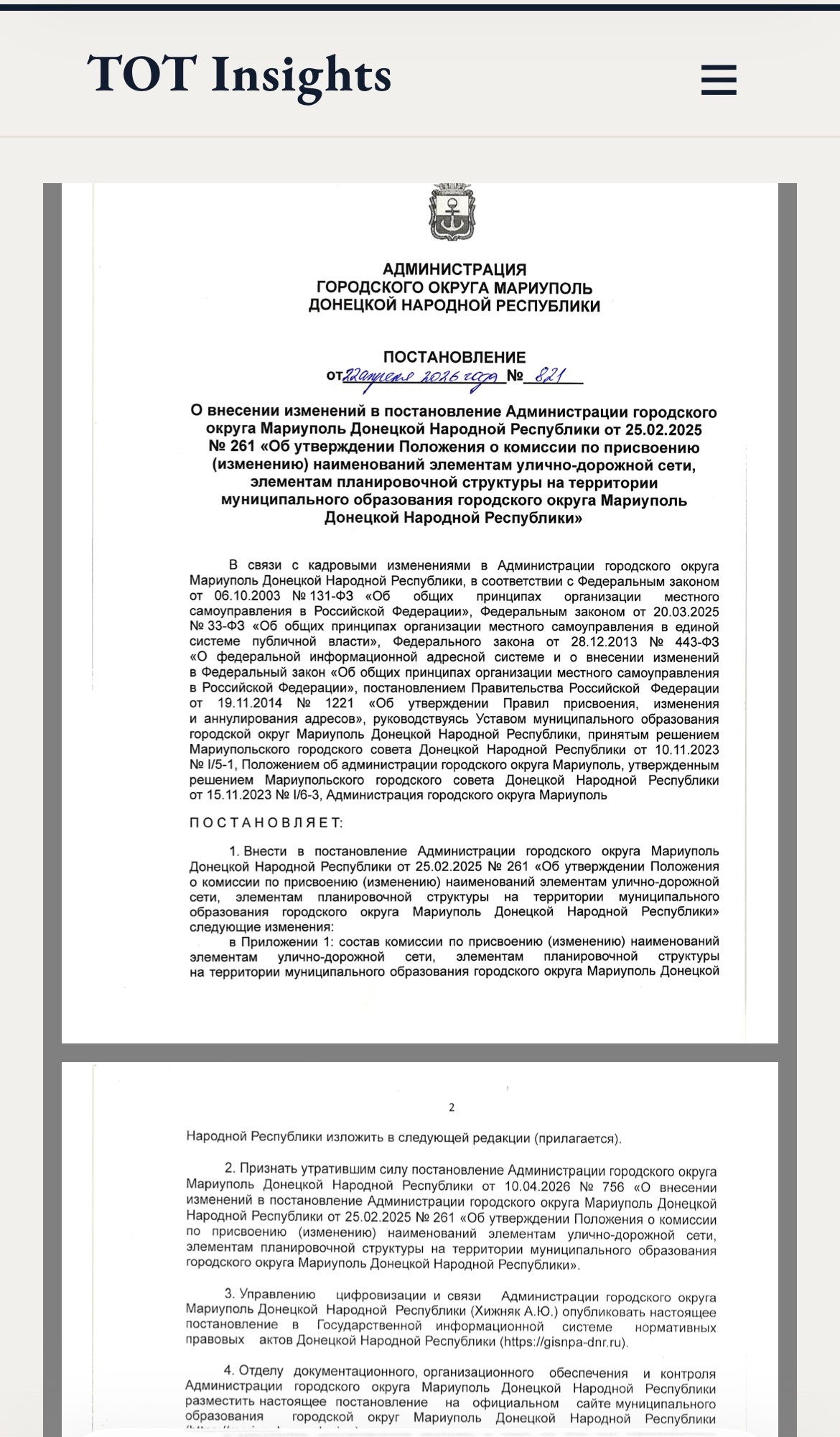
Decree on renaming streets in the occupied ‘Donetsk People’s Republic’, taken from totinsights.org
Too often, when the occupied territories are discussed, it is to analyse a snapshot, a crime, a particular atrocity. There is rarely space to address the systematic nature of what Russia is doing to the people and lands it has conquered, to probe at the gap between what you glimpse, through the newsfeed, of the process and what the process is actually leading to. The gap is the reason we built the TOT InsightsHub.
All wars run on two clocks: the first is the clock of the event, fast and legible, reaching us as a strike or a filtration camp or a number of dead, and real while also working as a kind of decoy. The second clock runs beneath it, slow and close to silent, carrying what the first cannot fully show. The French historian Fernand Braudel called this deeper time the longue durée, the time of structures rather than of the afternoon’s updates, and the difficulty with structures is that they are often invisible from inside the present. Understanding of a structure characteristically arrives only in retrospect, once its shape has hardened and it is already too late to have acted otherwise. I worry that this is exactly how we will come to understand the occupied territories, comprehensively and only once that comprehension can no longer be of use.
The wager of the hub is that the territories have been occupied long enough to allow us to read the slow clock while it still runs, to etch out the structure while something might still be done.
What is happening in the occupied territories is the Russian construction and imposition of a new reality over the old one. In time, the seams of this displacement will begin to disappear and children will grow up for whom the graft is simply the ground. Another way is to imagine the time before occupation as a palimpsest, a page scraped and written over with the original still faintly legible beneath, and the hub exists to document the process of re-writing, which it does in the least romantic way available by building databases and cohering and triangulating data.
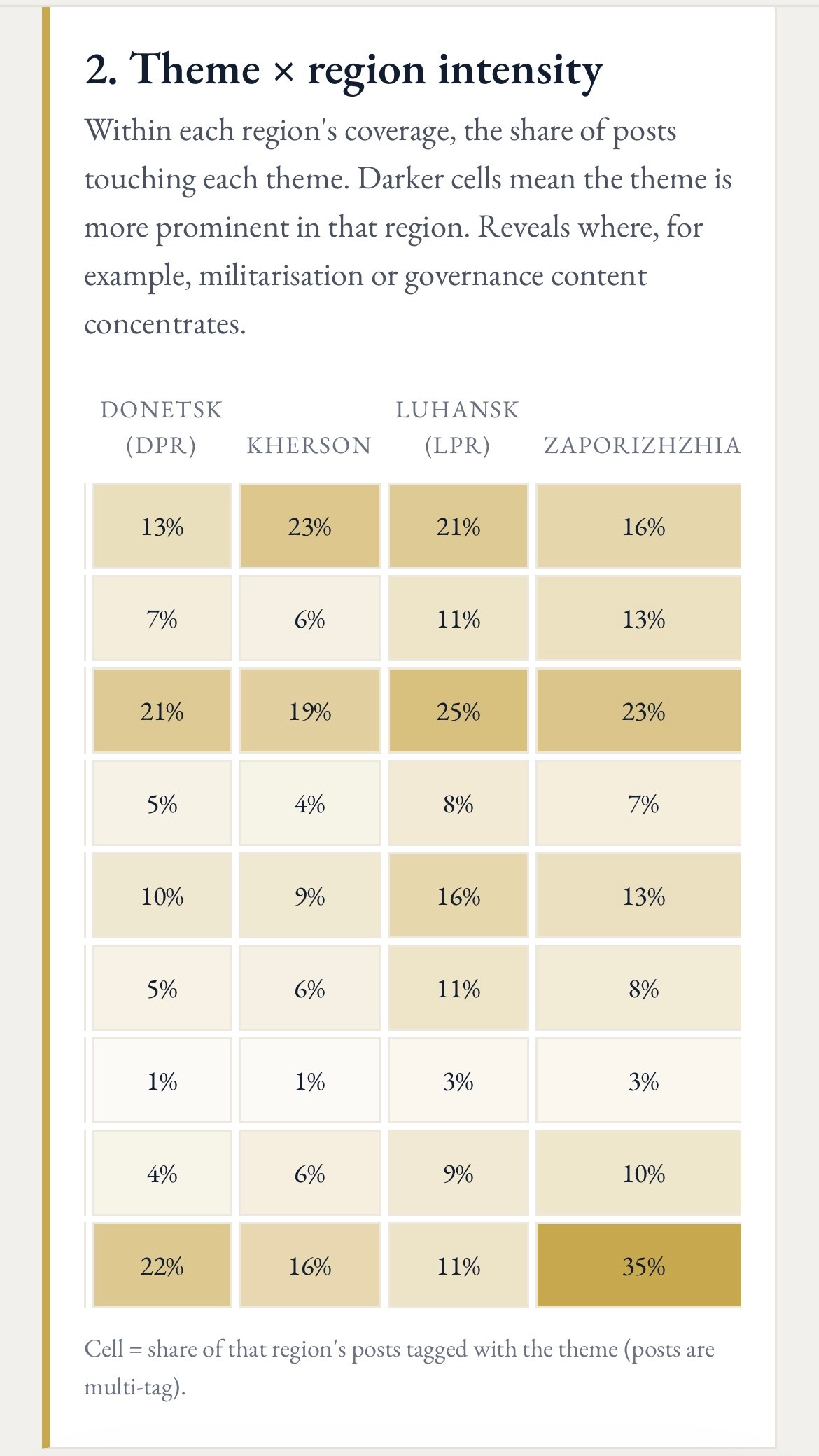
Snapshot from totinsights.org
Every layer of the graft leaves a record of some sort. The layer that looks most like paperwork is the most radical. In Mariupol we analyse an (incomplete) occupation lost of 5,979 residential properties entered into a register that certifies them as ownerless, most flagged for transfer into municipal hands, through a mechanism that needs no court, since an official inspects a flat, records it as abandoned, and is not obliged to tell the owner, whose home is simply stolen. Elsewhere, entire religious communities are erased, including Jehovah’s Witnesses and Ukrainian Orthodox churches. Protestant denominations have been reduced to a single approved church and dozens of clergy killed or tortured to death. In an interrogation in Melitopol one Russian security officer put the underlying claim more plainly, telling a pastor that his churches were temporary and that only the Orthodox Church would remain.
The notion that Ukrainian reality was the temporary impostor, to be replaced by – or, in their framing, restored to – the Russian reality emerges throughout every theme on the hub. But it is most obvious in the discursive layer, tracked through a media database of more than 22,000 Russian posts about the territories and through the occupier’s own teaching materials and reading lists, the record of what a child in occupied Mariupol is handed to read.
The hub’s study of the Voin generation documents something in the order of 600,000 children in the occupied territories going through a heavily militarised education system. Set beside child deportation and conscription of Ukrainians to fight Ukrainians, this is the graft worked on the person rather than the building Many of the children being trained now will reach conscription age between 2028 and 2034. In those territories occupied for longer, many have already been conscripted.
The more you read about the occupied territories, the more claustrophobic it becomes. Sadly, the trap comes from many sides and while Russia alone is responsible, the Ukrainian state’s legal responses sometimes reinforce the lack of options. A Ukrainian under occupation must still earn a living, and collaboration law can render that living criminal, so that a nurse or a clerk continuing to work is at once sustaining a family, acting within international humanitarian law, and committing a prosecutable offence under Ukrainian law, with over four thousand judgements handed down, many in absentia, and courts treating continued residence itself as evidence of siding with the occupier. Caught between two states, penalised by one for surviving the other, these people are also the point at which the graft catches the rest of us, in the foreshortening that reaches for the word collaborator where the truth is someone standing on a very small piece of ground with a wall behind them and in front of them.
The name of the hub is TOT insights, using the acronym ‘Temporarily Occupied Territories’. This is itself a claim about time, a promise that this is a parenthesis after which normal time resumes. In many ways, the acronym becomes an act of fidelity or a refusal to concede what has not been lost. But the term ‘Temporarily Occupied Territories’ can easily slide from fidelity into alibi, speaking in the future perfect to avoid asking any questions of ourselves now. Meanwhile, the people living under occupation remain in a present tense that guarantees them nothing.
Given the attritional nature of the war and the new innovations in strategy, operations and tactics that have emerged from the impossibility of seizing momentum on the frontline, I increasingly think of the occupied territories as the space where the war will be won or lost in the longer term. I will advance two arguments here, each of which turns on time.
The first is military. If Ukraine and its partners can make holding the territories genuinely costly and militarily pointless for Russia, by striking the logistics, command and control, fuel and military-critical infrastructure on which the occupation depends, and through the coordinated resistance networks whose activity the hub records in hundreds of documented incidents, then one core component of a Russian victory is denied. A territory that cannot be exploited, garrisoned or safely held as a rear area is a territory held at a loss. This may not shift Putin’s decision making but is likely to impact any successor who will likely be less obsessed with or by Ukraine. It also sends an important deterrent message: Russia’s invasion, its waste of blood and treasure was just that – pointless waste.
The second aspect is human, and turns on identity rather than terrain. Beneath the fighting over ground lies a collision of two identities that cannot both be satisfied, a Russian great-power self-conception that must hold Ukraine and a Ukrainian one that must be sovereign. This is why the territory was never really the issue: had Ukraine consented to be another Belarus, Russia would have had no need to take the territories at all. But that would have involved Ukraine ceasing to exist as a sovereign, truly separate country, which is precisely the price Ukrainians refuse to pay.
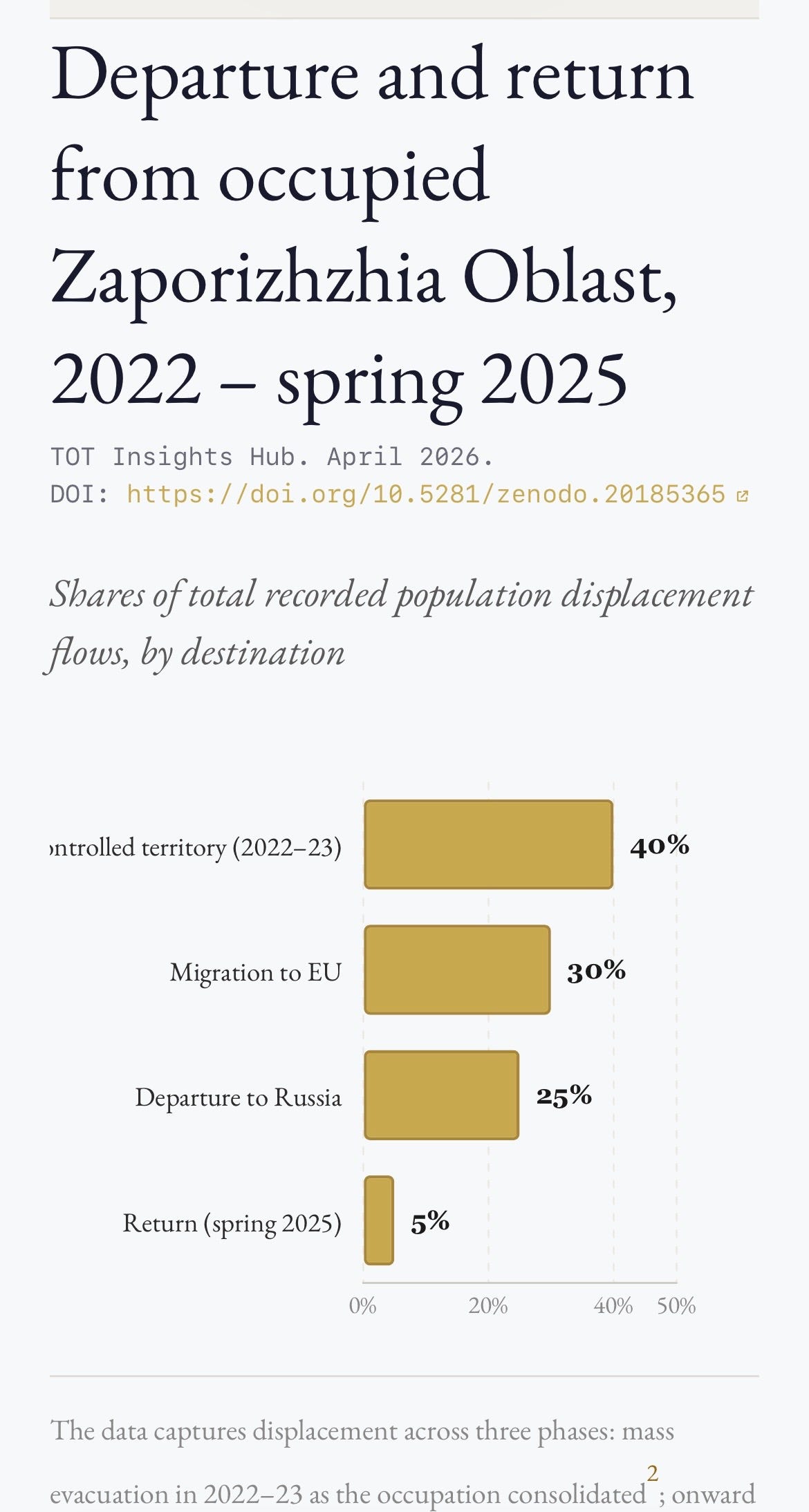
If the war is ultimately a contest over identity, then identity is also what is being fought over inside the occupied territories, and the graft I have described is the instrument of that fight. The harder it remains for Russia to remake the people of the occupied territories, the more genuinely temporary the occupation becomes, because a population that still feels itself part of the Ukrainian nation is a graft that will not take. The treatment of the displaced is therefore a component of the strategic question rather than a humanitarian footnote to it. Millions have left the occupied territories, and our polling of internally displaced people finds close to half still in direct contact with friends and relatives who remain, which makes the displaced a living connective tissue between the territories and the rest of Ukraine, and their sense of welcome or abandonment a strategic variable rather than a private sorrow.
That same polling should discipline how we speak about those who stayed, since a clear majority of the displaced reject the claim that people under occupation are content with Russian rule, and yet it is the minority impression of contentment that tends to shape outside commentary on collaboration. It also tells us what help is actually wanted, because the assistance the displaced themselves rate most worth its risk is help with evacuation, then assistance with medicine and essential goods.
This raises the practical questions the hub is meant to inform. For those still inside, what evacuation routes genuinely exist, and what becomes of a young person who reaches Ukrainian-controlled territory without documents that Ukrainian institutions will recognise? Here I want to pay particular tribute to Bohdan Krotevych, whose tireless lobbying secured recent changes to help young people leaving the occupied territories establish their identification once they arrive. That those changes are, for now, only temporary is its own comment.
It is not enough to study any of this. I hope the hub will be useful to policy that has effect, and I am clear-eyed that some of the work of turning evidence into consequence has to be done in other guises, not under an academic hat. But I hope the academic work can at least be used to inform and evaluate such efforts. Returning to Voronezh, it becomes clear that the abandonment the Donetskers described was the (Russian) system working rather than failing, cutting people off from every reality that might have held them while everyone else described their condition and acted on none of it. The hub is an attempt to bring together people, data, and analysis to fix as much of the truth of the present as we can before it is overwritten or falls into Arendt’s hole of oblivion, the arrangement by which a person can be made never to have been what they were. We will all understand the architecture of the occupied territories in time, and the only question that matters is whether we understand it while comprehension can still change what happens, or afterwards, once it has hardened into historical record and can change nothing.
Very impressed by this analysis. It opened a new way of thinking about the issues for me. Thankyou.
Interesting. Made me think of 911 and the structures that emerged following.