
Memory Traps

This text was originally delivered as a keynote speech for the launch of a special issue on Russian memory politics in the far north of Russia and Norway in Journal of Soviet and Post-Soviet Politics and Society. Edited by Kari Aga Myklebost, Håvard Bækken, and Stian Bones, the special issue is the culmination of the seven year Normemo project, expertly led by Professor Myklebost, through war, plague and then even more war. The special issue itself will be available open access HERE.
The text of the speech below has been lightly edited for clarity.
Memory Traps. Russian historical propaganda at home and abroad
“For our country, it is a matter of life and death, a matter of our historical future as a nation. This is not an exaggeration” With these words on the morning of his full-scale invasion of Ukraine in February 2022, President Vladimir Putin framed the invasion of Ukraine as a civilizational struggle, a battle for history itself. Its stakes are visible daily in Ukraine, from the bombing of children’s hospitals in Kherson to the dismantling of Holodomor memorials across occupied territories.
This special issue makes a major contribution to understanding lesser studied contours of that battle. It offers one of the most detailed portraits yet of how the Putinist memory regime operates: centralised yet locally adaptive, built on interplay between federal directives, regional actors, and transborder partners. Russia’s memory regime is metamorphic, its narratives mutate as they travel, absorbing regional symbols and emotions without losing strategic purpose. This flexibility is what makes the system so effective: its narratives ensnare local actors in memory traps, frameworks that may appear diplomatic or patriotic but ultimately bind them to Kremlin-defined history.
The case studies trace how the Great Patriotic War narrative is localised through youth movements like Yunarmiia, embedded in schools and libraries, and exported through commemorations in Norway. They reveal a dual dynamic: the Kremlin’s drive to securitise history and its dependence on local and foreign partners to make that project emotionally persuasive. In doing so, the collection moves beyond a Kremlin-centric lens, showing memory politics as a multilevel system linking indoctrination, occupation policy, and foreign influence into one authoritarian mechanism of historical governance.
In my talk today, I build on this foundation to examine how these mnemonic mechanisms operate under conditions of war and occupation. Drawing on the collection’s mapping of institutional architecture, I focus on operational logic: the way narratives, rituals, and emotional cues are deployed as instruments of cognitive warfare (that is, warfare targeting perception, emotion and reasoning, rather than physical destruction), shaping how people perceive reality and legitimising violence as historical continuity. To show how historical narratives are being operationalised as tools of strategy - to mould domestic opinion, assimilate occupied lands, influence foreign societies, and justify a brutal war as the continuation of a sacred past—I want to trace how Russia’s “memory war” is structured and why it matters, following its trajectory from the Kremlin’s domestic memory regime to the battlefields of Ukraine, and, of course, via Norway.
The Domestic Memory Regime in Putin’s Russia
Inside Russia, the state has institutionalised a preferred past. The Great Patriotic War sits at the centre—elevated to the level of civic religion with its own rituals and reenactments.
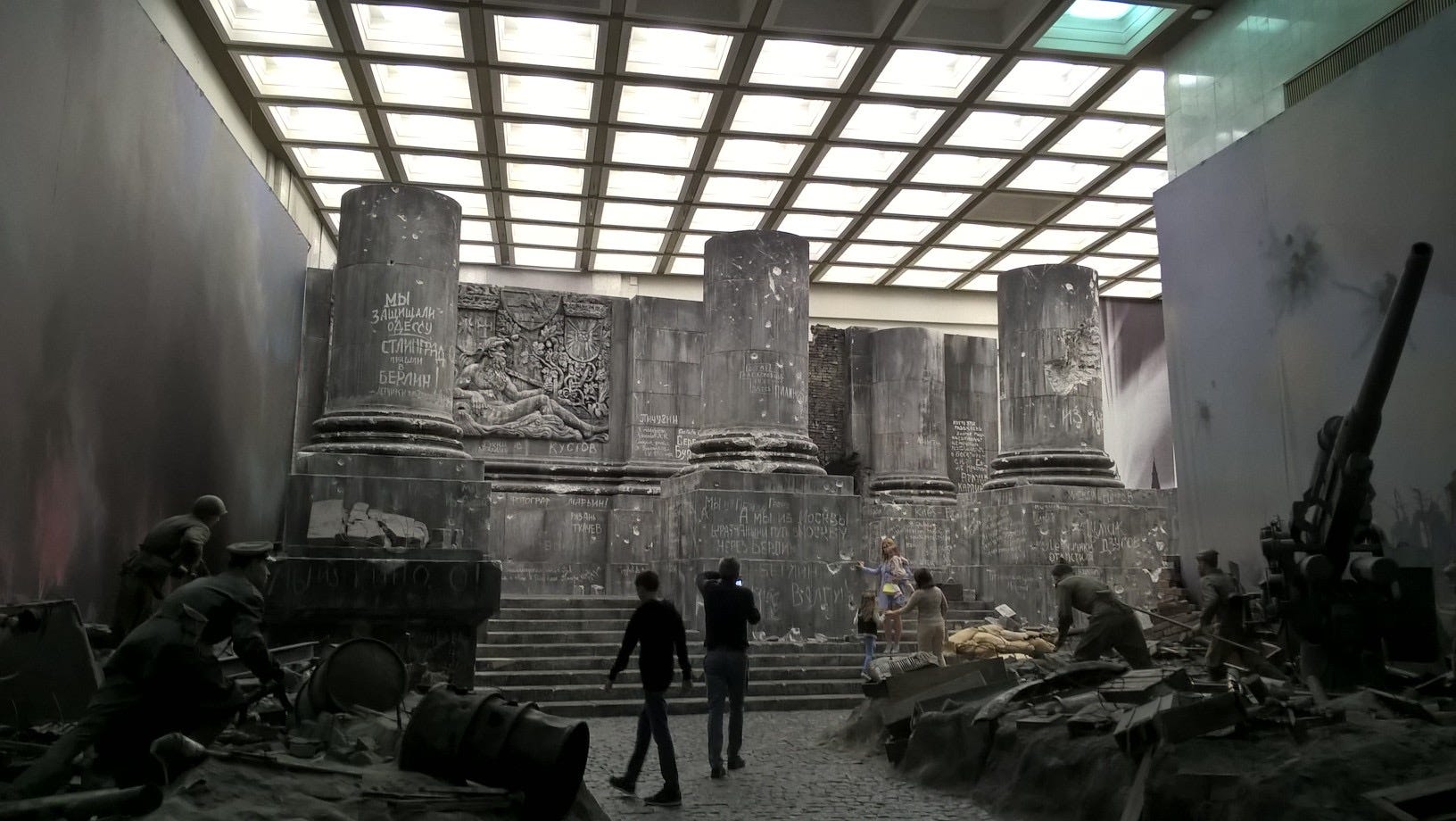
Replica Reichstag at the Moscow Victory Museum (own photo, 2018)
In 2014, state media and officials reframed the annexation of Crimea and the war in Donbas as a second liberation struggle, as Russia once again saving the world from fascism. Nowhere was this clearer than in the St George’s Ribbon, originally a tsarist symbol, repurposed in the early 2000s into commemoration, or rather celebration, of the Great Patriotic War. In 2014, it became a portable sign of allegiance to Putin’s narrative: wearing it meant standing with “our grandfathers who defeated Nazism,” and therefore with Russia’s military aggression against Ukraine. By linking present conflict to sacred wartime memory, the Kremlin collapsed distinctions between past and present, turning remembrance into mobilisation. These rituals function as memory traps, converting remembrance into obedience: to honour one’s ancestors is to accept the Kremlin’s version of the past. This conflation was undergirded by changes already underway to sacralise Kremlin views of the past and delegitimise others’.
In 2020, constitutional amendments enshrined the duty to “protect historical truth” and prohibited “denigrating” the Soviet victory in the Second World War. These measures were backed by laws that punish “false” interpretations of history, effectively turning deviation from the official narrative into an act of disloyalty, even treason.
Education has been a central arena for this memory politics. Russian school textbooks and curricula now advance a single, patriotic storyline that culminates in the victory of 1945 and flows seamlessly into the present-day Russian state. Post-2022 textbooks deliver a tightly curated narrative of national greatness and grievance. Yet, as Helge Blakkisrud observes in his article Teaching the Great Patriotic War, this process began long before 2022.
The state’s historical narrative extends well beyond the classroom. Popular culture—state-funded films, novels, and television dramas about the war—reinforces this mythic version of history, often featuring “treacherous Banderites” as the eternal enemy. Youth movements play a similar role. From The Movement of the First, which instils political loyalty in the youngest citizens, to Voin camps where children are taught to shoot at images of Kyiv, the cultivation of militarized patriotism is pervasive. At the top of this pyramid stands Yunarmiia, the “Young Army” movement launched in 2016, which now claims nearly 1.85 million members. With its uniforms, drills, oaths, and memorial pilgrimages, it braids local pride into the national story, as explored in the article “The Little Motherland”.
Since 2022, these long-standing initiatives have been folded into a broader restructuring of education under the banner of vospitanie, or the moral and civic “upbringing” of youth. The introduction of school “curators,” the weekly “Lessons About the Important,” and a network of state-sponsored cultural foundations mark this intensified effort to align education with state ideology. Yet it is important to remember that before 2022, this was often a process of co-optation as much as coercion. In my DPhil fieldwork on the co-construction of memory narratives, community historians and reenactors, even those wary of state monopolies on the past, accepted government grants, honorary titles, and jobs, falling into traps.
Where they resisted, state-backed “memory GONGOs” (government-organized NGOs) stepped in to take over their initiatives. The Immortal Regiment exemplifies the coercive muscle applied. The regime quickly grasped the power of this grassroots ritual—originally launched in 2012 by opposition journalists as an apolitical act of ancestor remembrance—and by 2015 had absorbed it into a state-run spectacle of patriotic devotion. The ritual’s emotional intimacy, grounded in the near-universal experience of family loss during the war, made it a potent tool for national mobilization.
Alternative memories, however, are systematically suppressed. The Sandarmokh mass grave in Karelia—analysed in the article Contested Memories of the Violent Past in a Border Region: The Memory Politics of Stalinist Terror and Finnish Occupation in Post-Soviet Karelia—is emblematic. Once recognized as a site of Stalinist executions, including many members of Ukraine’s prewar intelligentsia, Sandarmokh has been reinterpreted in official discourse as a Nazi atrocity. Soviet crimes are thus inverted into a narrative of eternal Russian victimhood and heroism, a historicisation of what might be called the “Bucha tactic.”
From the classroom to the parade ground and television screen, the regime advances a single, sacred myth: Russia as righteous victor, forever engaged in the continuation of its “Great Patriotic” struggle. This myth provides both the moral engine and the ideological ammunition for the ongoing war against Ukraine.
Imposing the Memory Regime in Occupied Ukraine
When Russia seized territories (Crimea, parts of Donbas, and, since 2022, far more), it exported its memory regime to overwrite Ukrainian identity. Education was targeted first: Ukrainian curricula purged; Russian textbooks imposed; libraries “cleansed.” Since 2025, Ukrainian-language classes are effectively banned. Teachers, academics, and librarians are sent to Moscow and St Petersburg for re-training in an imperial storyline. Under occupation, deviations are treated as “extremism” or “terrorism” and any competing narrative as an IPSO. But bluntly, nobody pays much attention to the destruction of the past in the occupied territories - indeed nobody pays much attention to the destruction of the present, to the estimated 20,000 deported children, 15,250 civilians detained, to the 203 black sites where they are held (OHCHR). There are no journalists able to work in the occupied territories, no journalists to tell us of how the past is destroyed, how the present is destroyed, and how the future is being destroyed.
The militarisation of childhood is an even more intense version of the Russian example. As well as local offshoots of Yunarmiia and the Movement of the First, there are separate entities like “Youth of the South” and special initiatives aimed at deukrainianising pupils. Children march, learn first aid and weapons assembly, salute flags, are drilled in tactics and drones. Joining becomes de facto mandatory; parents resisting face threats that their children may be taken as “social orphans” or sent to boarding schools. Large swathes of the occupied territories are living through total collapse of the water infrastructure but resources for indoctrinating children can always be found. For anyone unclear as to why, I would recommend the words of Retired Lt Colonel Vorontsov, head of the Volgograd VOIN military club for children (Vanguard):“If you want to defeat your enemy, raise his children.” There are 1.5 million children in the occupied territories. Russia is raising them for an army to be used against Ukraine, and against those of us lucky enough to live further West.
Occupation shifts the earlier dynamic of “interplay” into domination. What metamorphosised under pressure at home is mimicked by force in Ukraine. The aim is erasure and replacement. Holodomor memorials are vandalised or removed; Revolution of Dignity symbols stripped; street names revert to imperial or Soviet figures or honour contemporary loyalists. In Melitopol, a monument to Taras Shevchenko was torn out; in Mariupol, after the city’s destruction, a Pushkin bust appeared near mass graves. Sites of Ukrainian mourning are co-opted for Soviet-style ceremonies, even as commemorations of Ukrainian tragedies are forbidden.
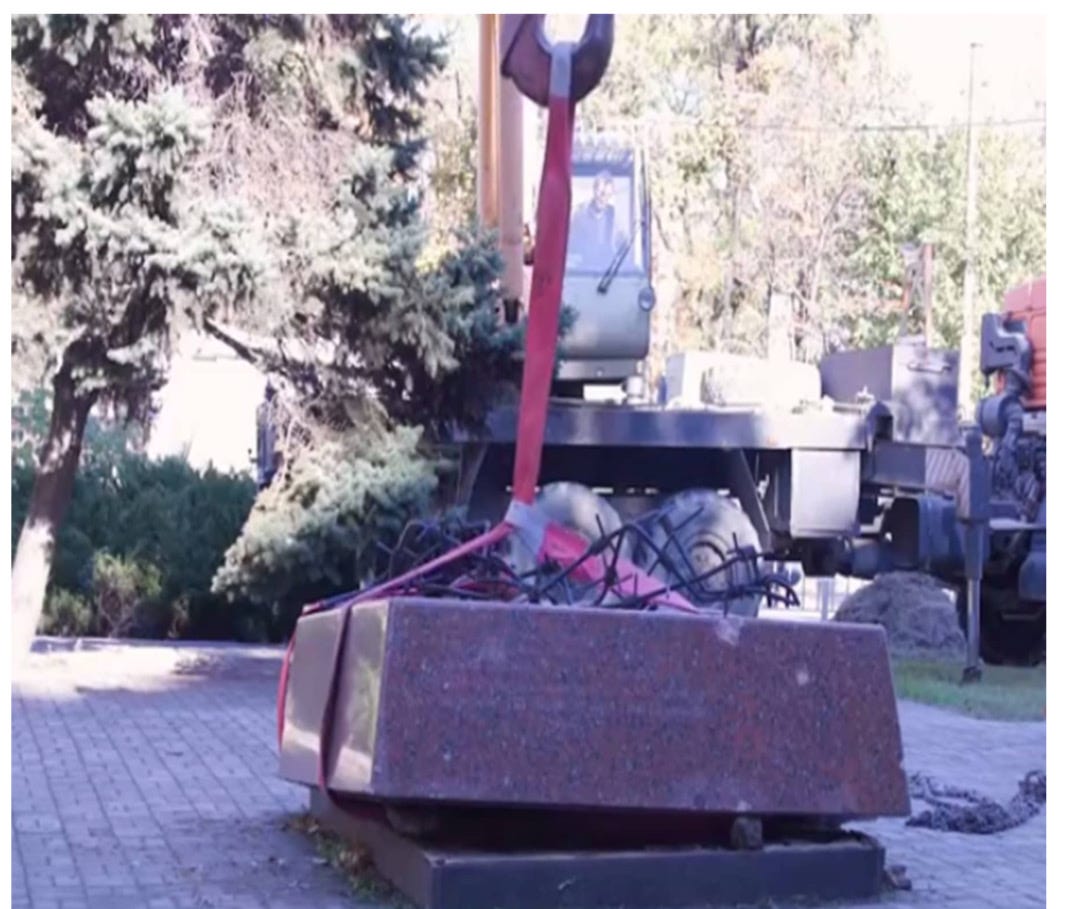
Removal of the Holodomor Memorial in Mariupol (Photo from Petro Andryushchenko, 2022).
As in the Soviet period, carriers of memory and identity, local historians, museum curators, clergy, community leaders, were are the first to face intimidation, arrest, deportation, torture, execution. I find it distressing to visit memorials and museums in honour of those tortured, murdered or imprisoned by the Soviets across eastern Europe. It is distressing not just because of the horror of the past but because I know of people going through exactly the same ordeal today, right now. Professionals who stayed under occupation to look after their patients, sentenced to fifteen years for reading pro-Ukrainian Telegram channels, the middle aged ladies disappeared for posting pictures stating a legal fact: their city is in Ukraine. Russia’s goal is to erase everything Ukrainian that cannot be folded into “Malorossiya”, Russia’s simulacrum of what it will allow Ukraine to be, a simulacrum it has been trying to impose on Ukraine for centuries, consuming and appropriating Ukraine’s history so it can embellish its own legacy and insist Ukrainians and Russians are “one people.”
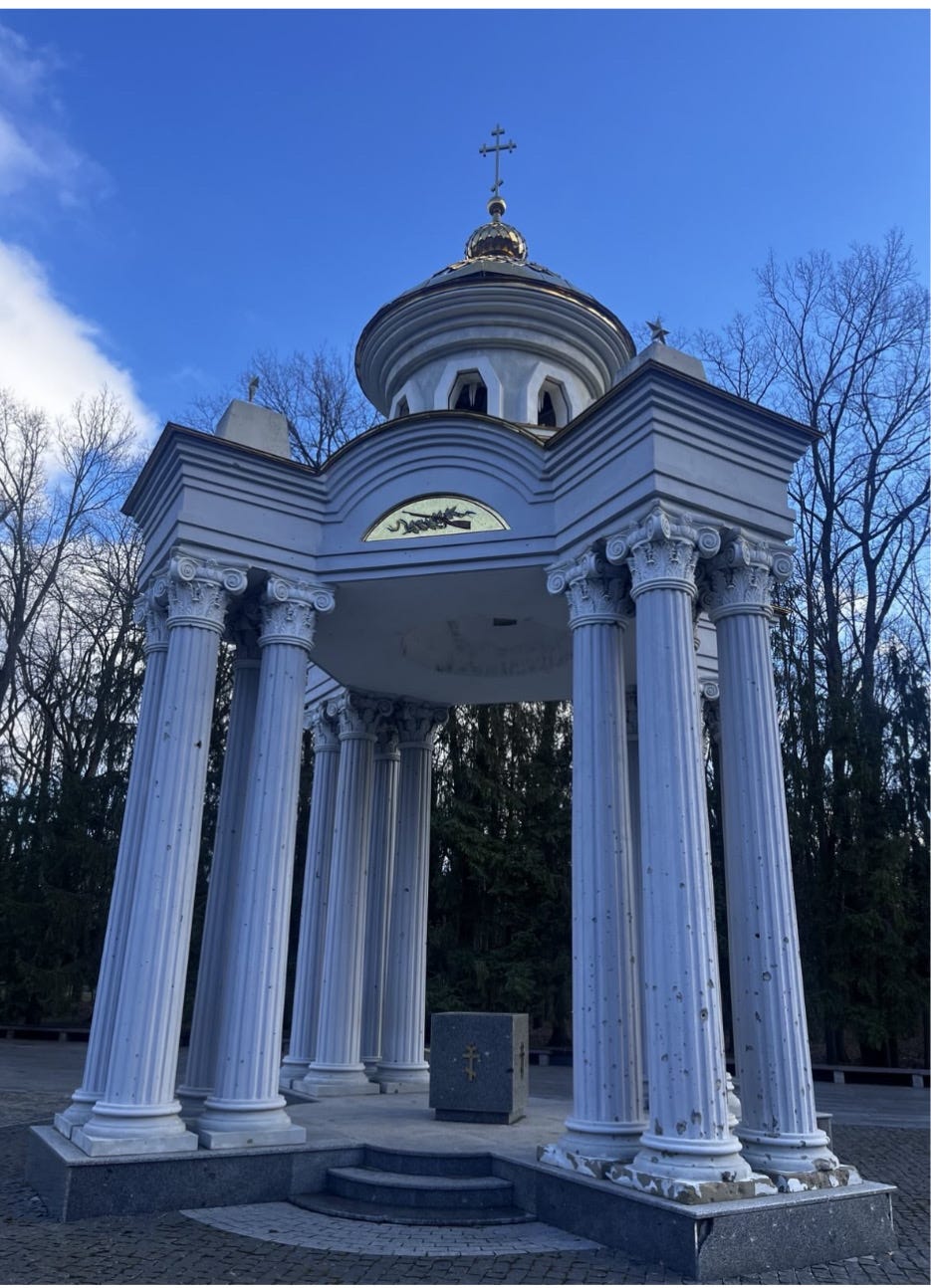
Chapel of the Archangel Michael (Own photo, 2025)
The story of the occupation is reduced in the media to a war over territory, but it is about identity and controlling – not respecting – history. The shrapnel scars on the chapel of the Archangel Michael, in Kharkiv’s monument to glory, a huge WWII memorial complex inaugurated in 1977, testify to that. In 2022, the Russians bombed this complex, and several other memorials to the Great Patriotic War and Holocaust, happy to destroy history in pursuit of owning its meaning.
Exporting the Narrative: Memory as a Tool of Foreign Influence (with Norway)
But of course, the Putinist regime cannot simply destroy memory in countries or areas it does not occupy, control, or bomb night after night after night. And this brings us to the profound value of the special issue we have gathered to discuss. In foreign countries, those it perceives as truly foreign rather than ‘the near abroad’, Russia adapts its memory toolkit to influence foreign societies. It can be conciliatory or confrontational, but the aim is constant: narrative dominance and borrowed moral authority. Abroad, Moscow sets new memory traps, inviting others into shared commemoration that masks manipulation—an emotional snare disguised as gratitude. Moreover the aggressiveness of its ‘outreach’ tracks the aggressiveness of its own literal militarisation of historical narratives, as the article on Empowering Memories of Liberation: The Kirkenes Red Army Liberation Commemorations in Norwegian–Russian Relations (1994–2019) sets out.
Focussed on Kirkenes/Finnmark where in October 1944, the Red Army liberated the northeast, the authors show how commemorations shifted after 2014. Long modest and confidence-building, after 2014 the tone and scale shifted: larger Russian delegations, patriotic memory tours from Murmansk (veterans, Yunarmiia, reenactors). On Norwegian soil, they displayed St George’s ribbons, Soviet flags, sometimes portraits of Stalin. Messaging folded WWII into the present: warnings about “neo-Nazis” from Ukraine and the Baltics; pleas to resist the “falsification of history.”
The operation sought a memory alliance with northern communities, playing subtly on regional feelings of neglect by Oslo, while implying that scepticism toward Moscow betrays shared memory. The Russian officials sought to use emotionally loaded symbols and repurpose wartime gratitude to soften resistance to Russia and to its geopolitical agenda.
Similar patterns can be seen in the politicisation of graves and monuments abroad. Modern Russian officials have reframed the bleak history of Soviet POWs in Norway, representing them in exhibitions within Russia to fit the martyrdom-for-Victory template and downplaying complexities like Stalin’s indifference to, and often outright suspicion of, returning POWs. This process is detailed in the article Militarizing Soviet POW Memories. Elsewhere, when Soviet statues are moved or renamed—Tallinn 2007 is the point at which memory assumed a physical role as an instrument or justification of acts of war - Moscow presents outrage as defence of “historical truth.” In fact, it is a defence of their right to wage memory wars on the rest of us, to export whatever they can of their domestic, criminal, approach to academic freedom and investigation. Even on Svalbard, official “Immortal Regiment” events have deliberately blurred remembrance with current war propaganda.
Across contexts, Russia toggles between bonding (“shared sacrifice, shared memory”) and browbeating (“you are ungrateful fascist revisionists”). The constant thread is their understanding of history as a political instrument and never as a scholarly pursuit of what happened in the past. As the Project Nordland Railroad article explores – and so many more examples from across the continent confirm - it has long been difficult to build any form of institutional study of history with Russian institutions; because this is not about the past but about politics in the present.
Memory as Cognitive Warfare
Why memory? Because historical narratives tied to identity and trauma are processed viscerally—they come pre-loaded with moral valence. For many Russians raised on tales of the Great Patriotic War, the word “Nazi” will trigger an instant reflex of revulsion and resolve. This is what psychologist Daniel Kahneman calls System 1 thinking: fast, automatic, emotional. Its counterpart, System 2, is slower and deliberate but often defers to System 1. Propaganda works best when it keeps people in System 1, flooding them with feeling before reason can intervene. In this sense, the Kremlin’s narratives are not just information operations but cognitive memory traps, designed to capture reflexes before reflection can occur.(I have many issues with the term cognitive warfare but that can wait for a different post).
The Kremlin has long cultivated this reflex, spiking “Nazi” mentions in state media at key moments—2014 and 24 February 2022. Repeated analogies between Ukraine and WWII primed the public’s intuition so that when Putin promised “denazification,” many Russians accepted it without question. The claim felt true because it fit a familiar emotional frame. This is the essence of cognitive warfare (as we define it in Western doctrine): shaping perception so that even falsehoods appear plausible and instinctive. Decades of state-curated memory created that lens. As Karen-Anna Eggen observes, Russia’s information confrontation is “a strategy for the weak,” achieving results brute power cannot.
Domestically, unresolved traumas, spanning the Soviet collapse, the chaos of the 1990s, and the silence over Stalinist crimes, left an identity vacuum. Putin’s regime filled it with an imperial narrative of pride, grievance, and collective narcissism: you are the descendants of victors; the world fears you for your strength; critics of your past seek to destroy your future. This taps classic System 1 drivers—pride, fear, anger—creating an interpretive prism through which millions now view reality. It leaves “no space for the future, only a reproducible past” that shelters people from the present. Faced with complexity, many revert to a moral script: Ukraine is run by fascists/Russia’s enemies.
Cognitive psychology shows that identity and emotion often trump facts. Persuasion succeeds through resonance, not evidence. The Kremlin exploits this brilliantly, amplifying themes such as “Russia the besieged fortress” or “gratitude to our grandfathers,” then letting emotional alignment do the work. Once a story feels right, people rationalise contradictions through motivated reasoning. Russian media thus functions as co-creation, testing and amplifying what resonates, mapping the population’s psyche and sowing compliant instincts.
Abroad, Russia applies the same memory tropes. Branding Ukrainians “Nazis” stirs old anxieties in Europe; invoking the Red Army’s liberation of camps or guilt-trips German audiences. These messages bypass analysis by appealing to inherited memory and identity. They also offer cognitive closure, or simple moral order amid uncertainty. For citizens unsettled by war or hardship, it is easier to believe in a grand patriotic struggle than confront moral dissonance. Cognitivedissonance theory explains the appeal: it’s less painful to adjust perception than core belief. In other words, forced to choose between changing your prejudices or ignoring reality, most people will ignore reality. The memory frame turns casualties and isolation into “sacrifices for a just cause.” Abroad, non-Russians fixated on Western hypocrisy or war crimes find in Russia’s narratives a ready excuse to avoid moral complexity; Russia doesn’t persuade them it was really about NATO, it just offers enough of a story to license their inertia, providing a cognitive firewall for their intellectual and moral cowardice.
Memory also binds groups. It forges in-groups (“we Russians, victors over Nazism”) and out-groups (“Ukrainians are Nazis; Westerners are Russophobes”). When politics fuses with identity, dissent feels like betrayal. Propaganda links today’s citizens to heroic ancestors, delivering pride (“we honour their victory”) and fear (“if we don’t fight, fascism returns”). It is a potent psychological lock-in against dissent and a lure toward conformity.
In sum, Russia’s memory war functions as a form of cognitive warfare, or at least as what NATO doctrine understands by this term. By continually activating emotional touchstones—WWII grief, pride, fear, love of motherland, it aligns instinct with policy. Once instincts are engaged, counter-narratives face an uphill battle against conviction. Memory thus becomes a weapon to bypass deliberation, secure consent, and prepare the ground for kinetic war, as witnessed in Ukraine.
Ukraine: The Decisive Test of Russia’s Memory War
In Ukraine, every strand converges. From the start, the Russian propagandists described the invasions in 2014 and in 2022 in the language of the Great Patriotic War: “denazification,” “liberation,” “Banderites”. This script shapes conduct. If opponents are “Nazis,” brutality becomes duty. Russian soldiers behave as if they are fighting “Nazis” and “liberating” Ukrainian cities just as the Red Army liberated Eastern Europe from the Third Reich. Think of the Soviet ‘Victory’ flags the Russian invading forces hang up over the quiet Donetsk towns they have obliterated. If you are convinced your enemy is a “Nazi” subhuman, committing atrocities against them or against civilians accused of supporting them becomes easier to stomach. If your enemy has no culture to destroy, what does it matter if you destroy it?
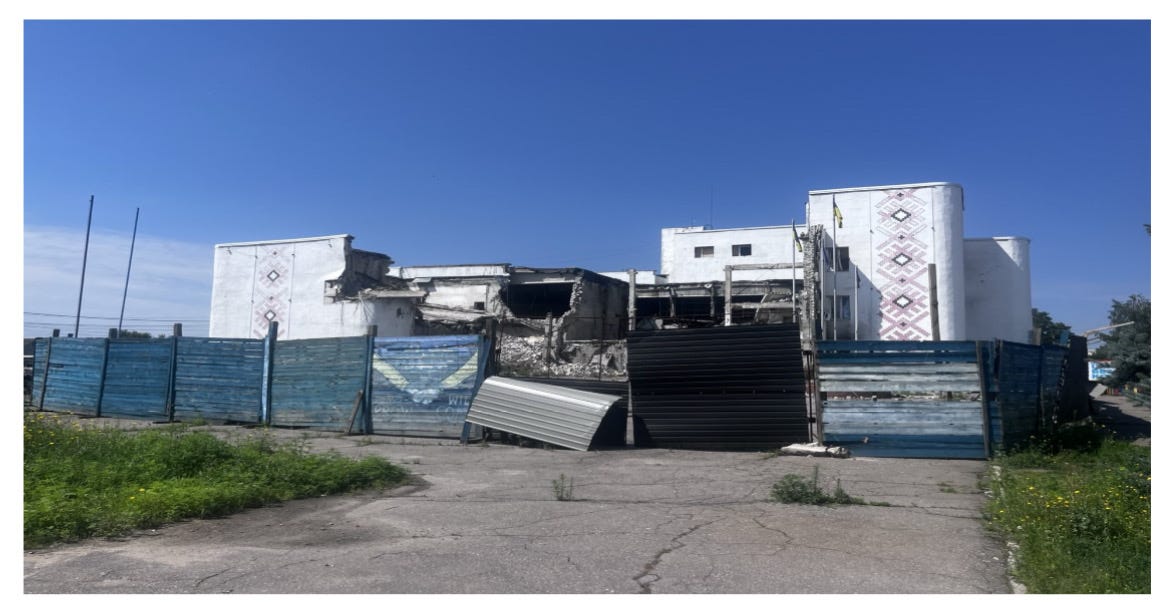
Community cultural centre, Derhachi (Kharkiv Region), 2025.
Yet the officials and propagandists cannot take all the blame. Some must be left for what is de facto the Russian state ministry for religion, but is known as the Russian Orthodox Church. The Russian narrative of a righteous war was enabled by what Dima Adamsky calls “nuclear orthodoxy,” where the fusion of church and the army, especially nuclear forces, works to sacralise national defence and lend metaphysical justification to brutal, terrifying, even world-destroying, violence. This has fed a sense of impunity and zeal among soldiers and paramilitaries, some of whom are, ironically, openly neo-nazi (Rusich, RIM).
The ferocity of Ukrainian resistance – both military and cultural – has so far signalled the limits to Russia’s effort to use memory politics to rewrite the future of our continent. But Ukraine is fighting alone and they are too often alone in understanding the mindset of their invaders. Too many otherwise serious-minded Westerners continue to forlornly search for ways to find common rational ground with Putin and his coterie, unable to accept those in charge of Russia are more interested in misremembered ghosts promising long lost treasure.
The JSPPS special issue I’ve drawn upon provides a broad roadmap to the mechanisms and consequences of this memory war as it will be directly waged upon us. Increasingly, Russia’s most brutal memory war is impacting us directly too. The special issue shows how Russian memory tropes manifest far beyond the Kremlin’s walls. Ukraine is just the most violent theatre of a larger confrontation over the history, identity, and future of our continent.
What Memory Clarifies
This war is rightly analysed through military and geopolitical lenses, yet memory and identity sit at its core. They explain why the conflict began in 2014 and why it will not end quickly. For Russia, control of the past is treated as a precondition for control of the future. The Kremlin’s memory politics are not simply manipulative: they are entrapments. They ensnare publics, elites, and even foreign observers in a web where emotion substitutes for fact and loyalty - perhaps to a proxy rather than directly to the Kremlin - for truth.
What does this demand of us? First, we cannot treat the Kremlin’s historical claims as decorative rhetoric. They are policy. The invasion flowed from a belief — or at least a performed conviction — that Ukraine is an illegitimate state whose very existence threatens Russia’s sacred historical narrative. The methods used, from mass bombardments of civilians to child deportations, consciously echo earlier imperial and wartime campaigns, as if reenacting chapters of Soviet and Russian conquest. This is not incidental. Putin has elevated the stakes to existential and historical terms: if Russia “loses” Ukraine, it loses itself. Under such conditions, traditional “compromise” solutions are structurally incompatible with the regime’s all-or-nothing civilizational framing.
Secondly, recognising the centrality of memory clarifies the international stakes. This is not only about NATO or resources; it is a contest over history and truth in Europe. A Russian victory would validate its imperial narrative, rewrite the history of Eastern Europe, downplay Soviet crimes, and deny agency to smaller nations. It would embolden further memory offensives, already visible toward the Baltic states, Kazakhstan, and Poland. Conversely, Ukrainian success would puncture the Kremlin’s myth. Battlefield outcomes will decide narrative outcomes.
For Ukraine and other states in Moscow’s shadow, this has underscored the importance of memory sovereignty. Since 2014, Ukraine has worked to globalise remembrance of the Holodomor, honour fighters against both Nazism and Communism, and anchor itself in a European rather than post-Soviet memory space. But the results are strategic, not symbolic: a society grounded in its real past is harder to subjugate through a false one. The same holds for us. We must insist on historical fact — that Ukrainians and other Soviet peoples suffered under Moscow, that WWII was an Allied victory not a solely “Russian” one, and that Soviet “liberation” was followed by decades of domination. Uttering the words Molotov-Ribbentrop Pact every once in a while will not help. No country has a pure past and no country has the right to dictate how another country – especially a former colony - should remember their own history.
This special issue of JSPPS is therefore invaluable. Its studies on youth militarisation, cross-border commemorations, the reframing of Soviet POWs, and community pushback show how memory has been securitised across domestic, regional, and foreign arenas. They demonstrate that Moscow’s warnings about “falsification” and “Nazism” were not stray propaganda, but expressions of the same ideology that led to invasion. What began as memory wars over statues, textbooks and anniversaries became kinetic war. Had we treated those early battles over history more seriously perhaps the warning signs would have been clearer.
Peace will remain impossible while the Russian historical narrative denies Ukraine’s existence. Russia’s memory politics are a core component of its neo-imperial project. This project can only be defeated or contained, not appeased.